29.6 °C


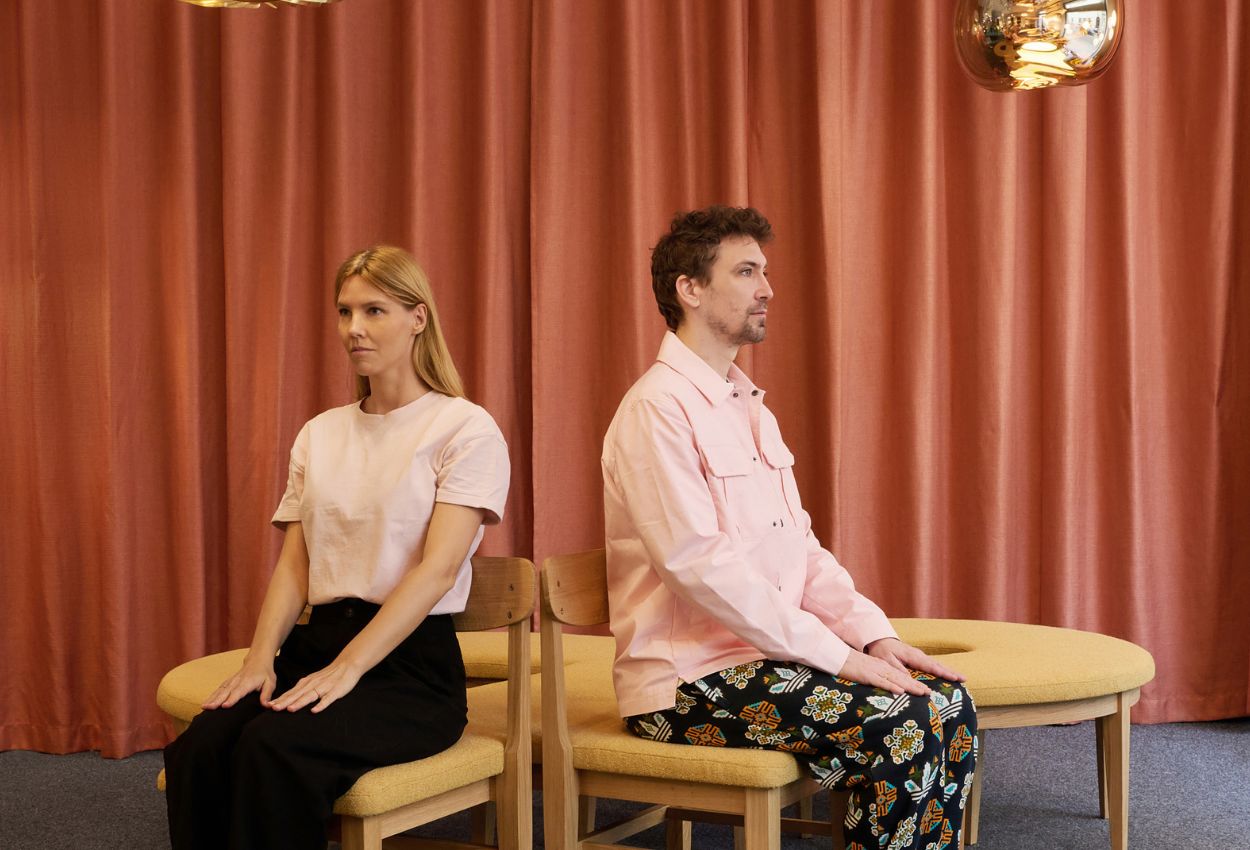
Two people sit on the same “furniture”, yet they look in different directions. The YOU&ME installation examines the paradox of intimacy: closeness and that which remains alone within us even in the closest relationship.
YOU&ME is an ampersand (&)-shaped, furniture-like object. You can sit on it with two people — you are present together, yet you look towards a separate horizon. The shape does not allow you to turn towards each other: the situation is physically shared, yet the turning remains. The work opens from here: from the simple, yet difficult to express experience that no matter how close we live in a bond, “somewhere in our heads we remain alone”.
Miklós Kiss formulates this not as a current trend, but as a universal human condition. According to him, the contradiction between loneliness and belonging is not a “present-day phenomenon”, but we talk about it more today — and perhaps we perceive it even more because of the accelerating world, online connectivity and impatience.
YOU&ME is both a seating arrangement and a thought experiment: in Miklós’ words, “it’s like a performance” that anyone can experience by sitting in it. One of the clearest parallels in the work comes from Pilinszky’s line: “the bed is shared, the pillow is not.” A sentence that expresses the same paradox as the ‘&’ sign: we are together, and yet we cannot be completely in the same place.
The expanded world, which has also shrunk
When Miklós talks about the change in connectivity, he does not moralize, but rather observes. Social media has expanded the world: more people, more impulses, faster exchange of information. But we do all this from a closed space — sitting in front of our phones or laptops. The world has become both bigger and smaller at the same time: attention spans are heightened, patience is shortened, and communication — especially in chat — goes astray more easily. We use signs to “prove” humor and irony, yet more misunderstandings and conflicts arise.
YOU&ME is therefore not only about two people, but also about the circumstances of connection: how difficult it is today to be together calmly, with presence, and how easy it is to seemingly connect.
A piece of furniture among furniture
The space of Home of Solinfo is not just a location: it is one of the statements of the work. Miklós made a conscious decision to have the installation appear here. If it is placed in a gallery, we “automatically read it as an artwork.” However, if it debuts among furniture, the categories are shaken: “what is it all about now?” — we ask ourselves.
The “cheating” here is not a trick, but a strategy: for the artist, the boundaries between high art, low art and design are inherently permeable. YOU&ME is also a high-quality piece of furniture — an object that could even fit into a large manufacturer’s collection. This makes it particularly exciting that sometimes the visitor simply sits on it without any special fuss: like a design product. And this is also part of the work.

Further thoughts: objects that are not just objects
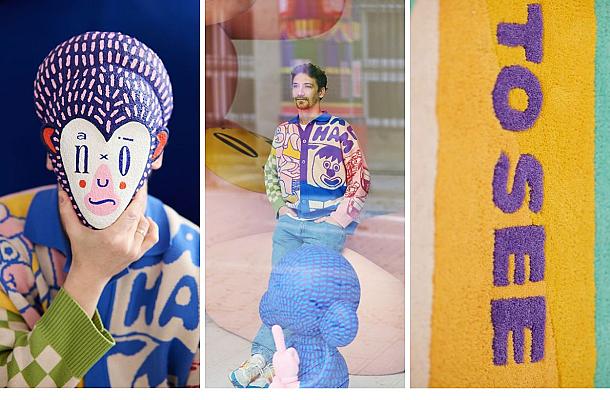
In addition to the installation, Home of Solinfo also features Miklós’ smaller-scale works — objects that can be purchased, which work with the same playful, ironic language while carrying serious layers.
Loved Bear, for example, is familiar at first glance: teddy bear, Valentine’s Day mood. But the heart-shaped cutout — “as if it were a wound that never heals” — immediately rewrites the formula: love is a risk, because we can also get hurt.
Cars race on the silk scarf, and Human Race does not mean “humanity” but the history of human competition: from the Olympics to arms races to tech and pharmaceutical competitions.
And the beauty of the tiger blanket preserves a tragedy: the memory of extinct species, the contrast between “GONE” and “HOPE”, and “RESET” the illusion of restoring the original state.
The objects here are not “complements” to the installation, but forms of the same thinking with different densities: sign, word, figure, surface — all speaking about the same thing.
“I didn’t want works of art, but an artist brand”
Miklós Kiss’s self-definition is perhaps the most precise key to the collaboration: he thinks of himself as a “visual artist” and thinks not only in individual works, but in a consistent world. In a language that can be transposed into an installation, an object, typography, and yet remains recognizable. In a brand — not in a marketing sense, but in a creative sense: in a complex identity spanning several genres.
And perhaps this is exactly what comes together in YOU&ME and in the context of Home of Solinfo: art does not remove us, but sits next to us. Next to a sofa. Between two people. In a sign. And it asks: how much can we really share with each other — and what is it that will forever remain ours?
Photos: Eszter Cseh