29.6 °C


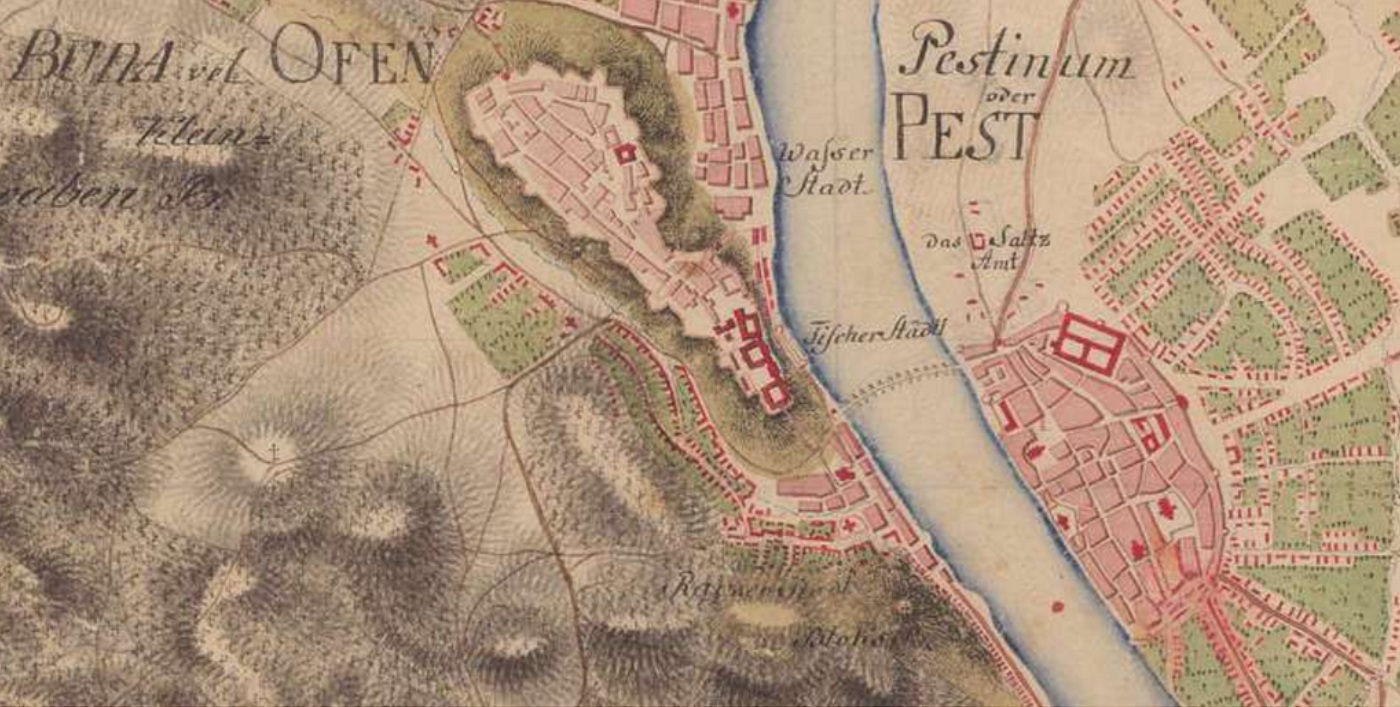
Think your commute is bad? Imagine a Budapest where the bridge was packed into storage every winter, leaving Buda and Pest completely stranded. Discover the wild, floating history of the Danube before the Chain Bridge!
Before the iconic Széchenyi Chain Bridge forever anchored Buda and Pest to one another in 1849, the Danube was both a life-giving highway and a formidable barrier. For centuries, the twin cities grew as separate entities, their economic and social interactions dictated entirely by the whims of a volatile and sometimes frozen river.
To bridge this gap, historical engineering relied on dynamic, floating solutions rather than stone pillars. The two primary mechanisms that defined life on the Danube prior to permanent structures were the flying bridge and the pontoon bridge.
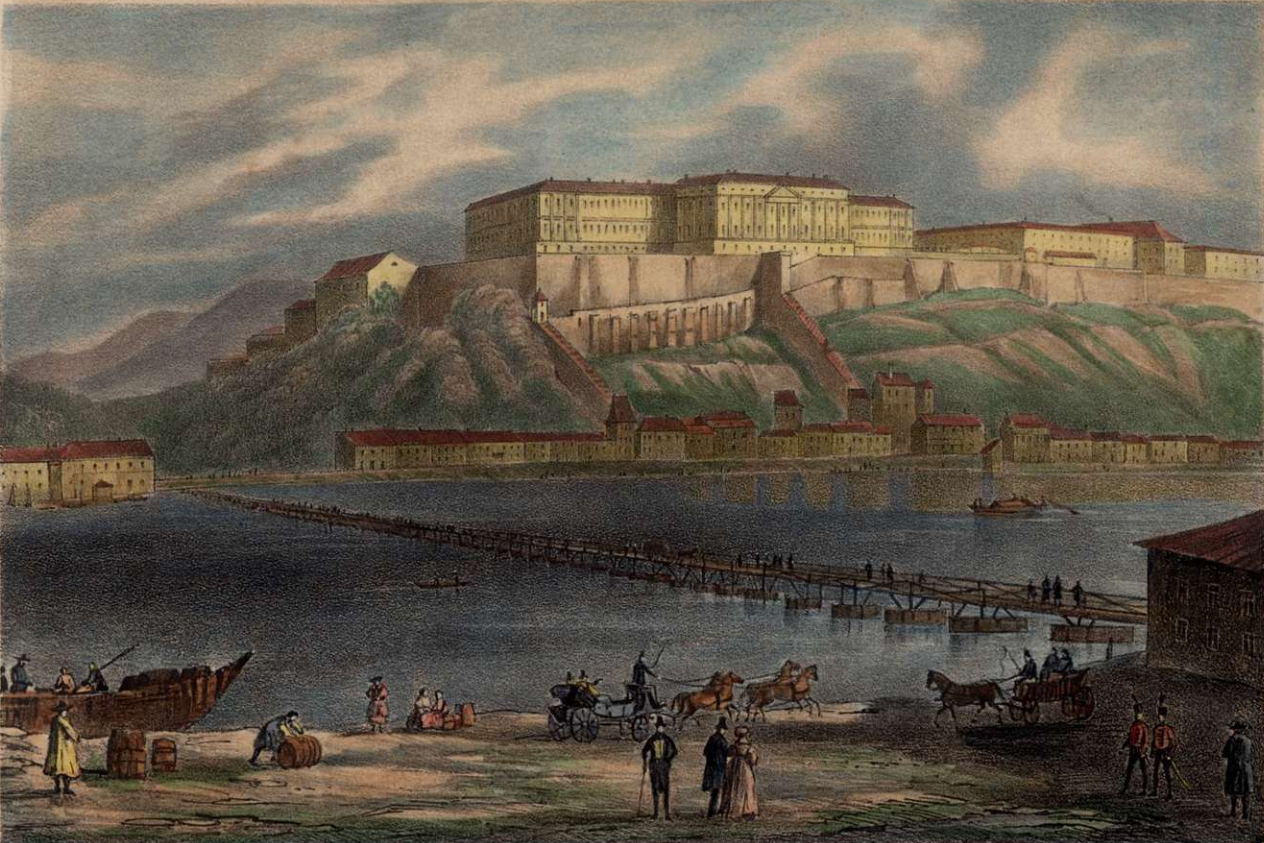
The royal castle with the pontoon bridge in the early 19th century.
The "Flying Bridge": Harnessing the River’s Own Power
Following the devastation of the Ottoman wars and the recapture of Buda in 1686, the immediate need to re-establish trade led to a clever piece of fluid mechanics: reaction ferry or "the flying bridge". Invented by the Viennese Vilmos Moller, this system began operating regularly around 1687, right after the recapture of the cities. The first reaction ferry on the Hungarian Danube was built in Pozsony (today's Bratislava, Slovakia) in 1676 more than a decade before the one between Buda and Pest. A flying bridge was not a bridge in the modern sense, but a highly specialized, pendulum-like ferry system. To construct one, engineers anchored a heavy chain or rope deep into the middle of the riverbed far upstream. This main line was kept afloat by a series of small, trailing buoys or boats. At the end of this long tether sat the main ferry—often a large platform built over two conjoined boat hulls, acting like a heavy catamaran.
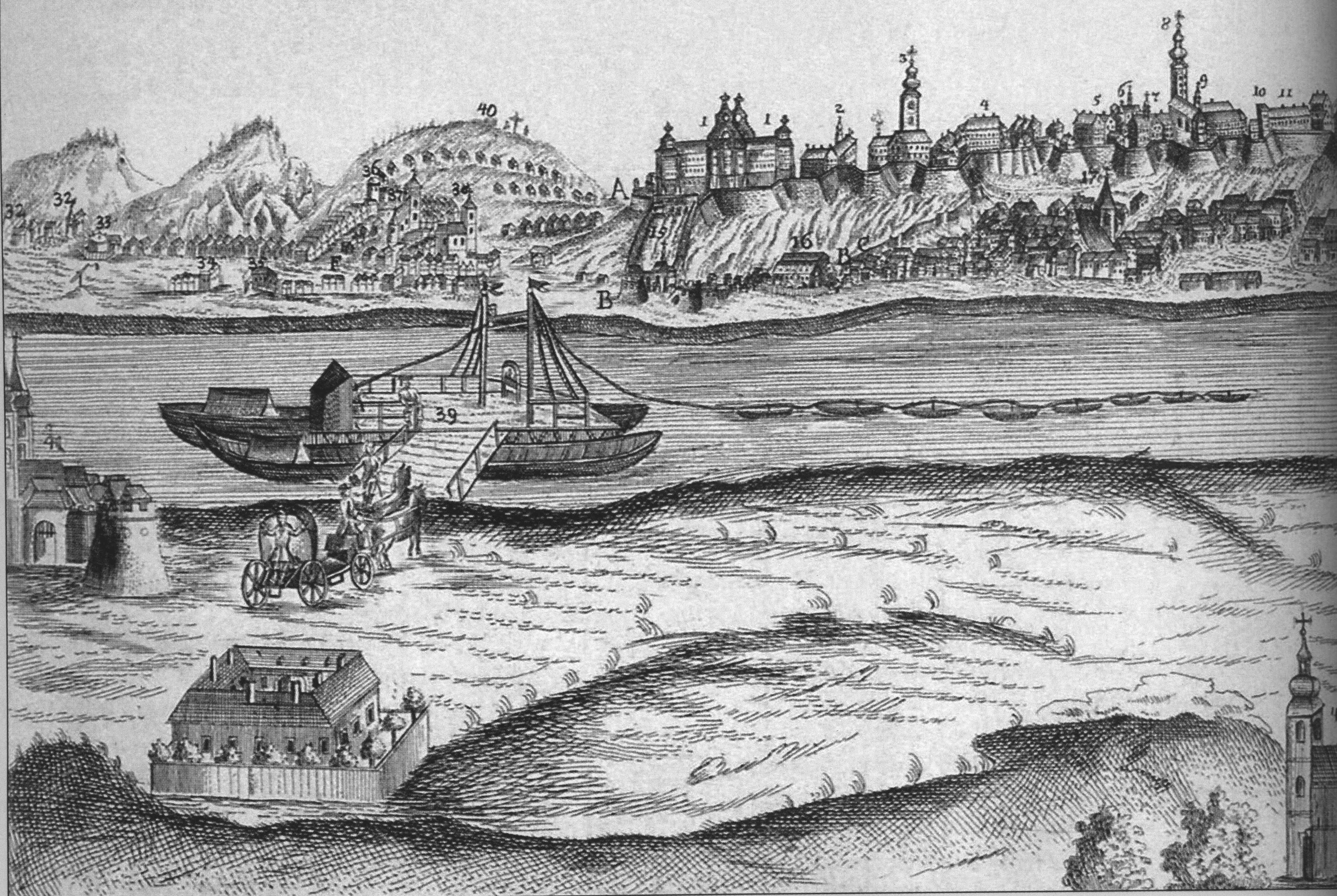
Reaction ferry between Pest and Buda. Drawing detail by Fülöp Binder János, Pozsony, 1735 (source)
By simply adjusting the ship's rudder and angling the hulls against the Danube's natural current, the force of the flowing water pushed the vessel sideways. It swung gracefully in a massive arc from the Buda shore to the Pest side, entirely propelled by renewable river energy. While ingenious, the flying bridge had limited capacity and struggled to keep pace with the rapid commercial expansion of the early 18th century.
The Pontoon Bridge: A Highway Built on Boats
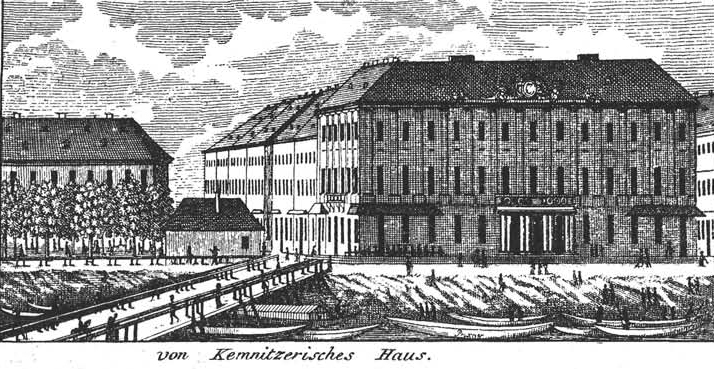 Angol Királyné Hotel with the foot of the pontoon bridge as pictured in 1803 (source)
As the twin cities transformed into bustling economic and political hubs, the pendulum ferry could no longer handle the thousands of merchants, cattle, and wagons demanding transit. In 1766, an official visit by Archduke Albert of Saxony-Teschen prompted the construction of an experimental, continuous floating path: the pontoon bridge.The experiment was an instant triumph. By 1767, it was established as a permanent seasonal fixture, stretching between 350 and 420 meters across the water. The wooden roadway rested flat across the decks of 42 to 47 large, specialized wooden boats (dereglye) anchored firmly against the current. At 9 meters wide, it was spacious enough to allow two-way carriage traffic, lined with pedestrian walkways and illuminated at night by oil lamps. Because the Danube was a vital shipping corridor, a central segment of the bridge could be unbolted and floated aside like a massive gate to let commercial river traffic pass through.
Pozsony introduced its own pontoon bridge in 1825, Komárom in 1837, and the archbishop's seat, Esztergom in 1842.
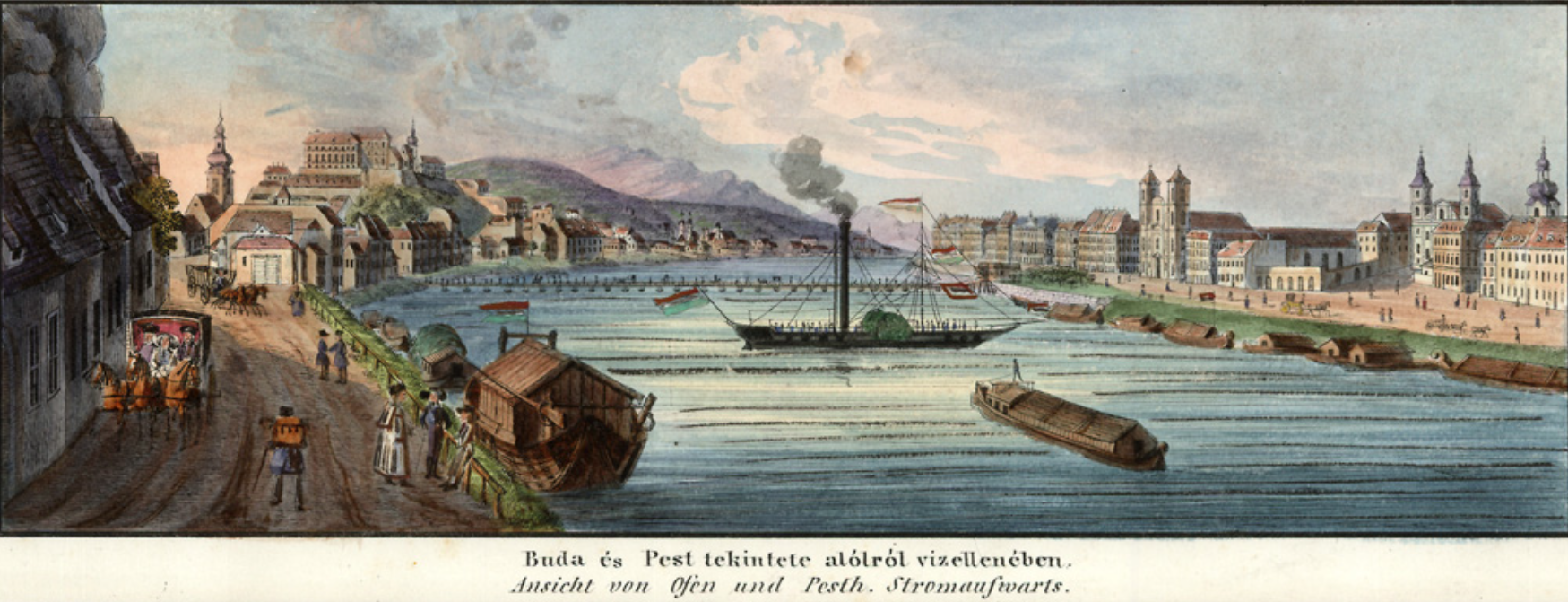
View of the twin cities with the pontoon bridge in the background as seen around 1837 (source)
The pontoon bridge was not just infrastructure; it was the social center of the cities. It hosted a small chapel dedicated to St. John of Nepomuk (the patron saint of bridges), and it served as the literal stage for historic events. On March 15, 1848, a crowd of twenty thousand crossed these very planks to carry the freed revolutionary writer Mihály Táncsics from his prison in Buda over to Pest.
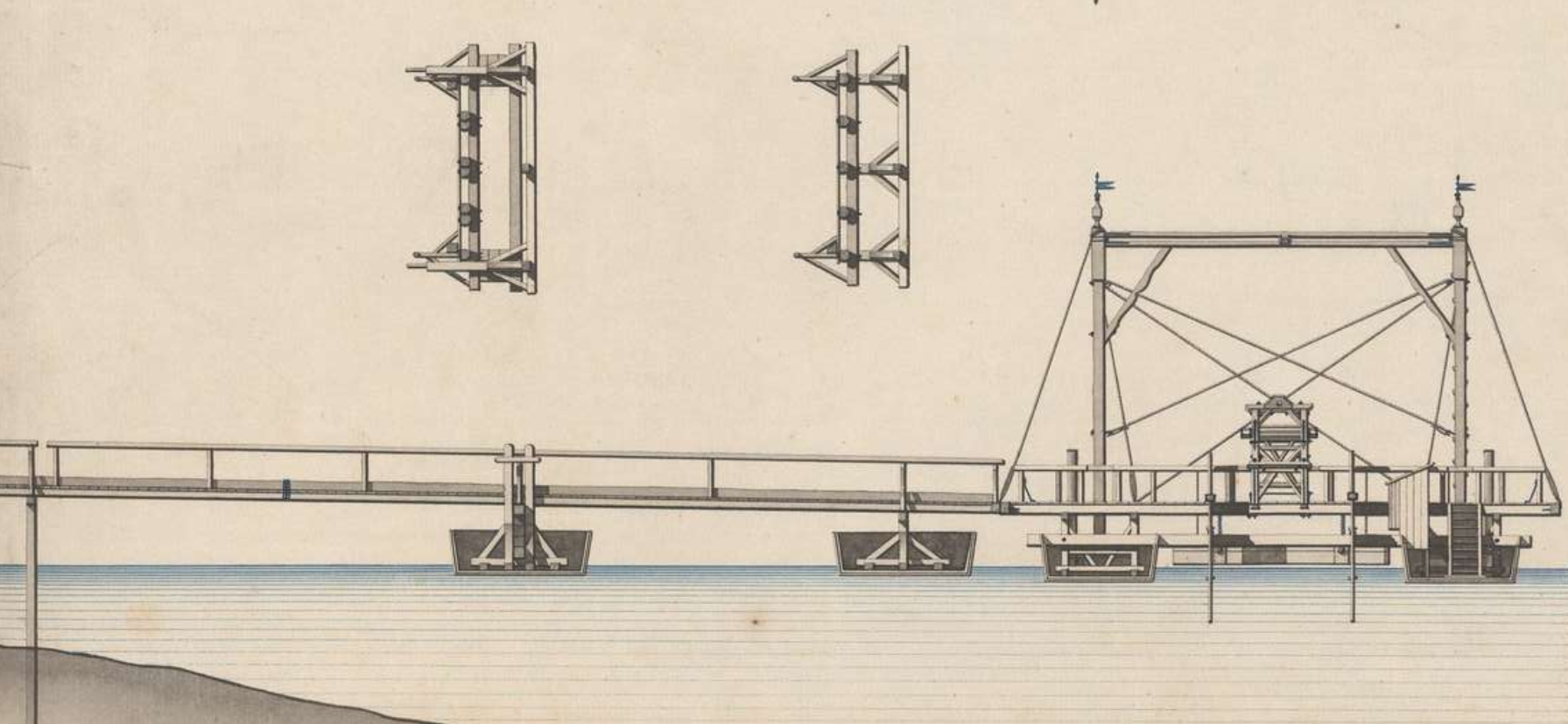
In 1790 a national Diet was held in Pest, and the increased traffic over the Danube could not be handled by the pontoon bridge alone, so they temporarily built a reaction ferry again for the time of the assembly. (image source)
The flaw of both the flying bridge and the pontoon bridge was their vulnerability to ice. Every autumn, usually around early December, as temperatures plummeted and ice sheets began to drift down from the Alps, workers had to dismantle the entire pontoon bridge piece by piece. The boats and planks were hauled out of the water and stored safely in specialized boat houses.
For several weeks or even months, Buda and Pest were completely severed from each other. If emergencies arose, brave souls risked their lives in small wooden skiffs weaving between grinding ice floes.
During exceptionally brutal winters, the Danube would freeze entirely, forming a thick, solid plain of ice. When this occurred, city authorities would officially declare an "ice bridge". Straw was scattered across the ice to create traction, and a makeshift winter highway emerged, allowing pedestrians and heavy sledges to slide across the river. However, a sudden thaw could cause the ice to rupture without warning, rendering the crossing lethal.
It was this exact winter chaos—specifically the winter of 1820/21, when Count István Széchenyi was left stranded for a week, unable to cross the river to attend his own father's funeral—that finally catalyzed the political will to build something permanent. The limitations of the pontoon bridge and the pontoon bridge directly paved the way for the stone and steel era of the Chain Bridge.